Physics Development Projects
Neutron Detectors for High Radiation Environments
One of our most significant physics development projects has involved creating neutron detectors for high radiation environments.
The Fukushima Dai-ichi Nuclear Power Plant accident in Japan presented unprecedented hazards addressed only through innovative, scientific research projects. Following the event, efforts to decommission the site required robust technology that could withstand extreme gamma radiation and high temperatures.
Innovative Physics was engaged to design specialist neutron detectors that perform with precision in the most demanding operational settings, directly supporting the plant's recovery and decommissioning programme.
Key aspects of this technology development project:
- Designed for the harshest civil nuclear environments
- Demonstrates advanced engineering processes and scientific rigour
- Offers critical radiation detection capability for ongoing site management
Decommissioning at the Fukushima Da-ichi nuclear power plant
Decommissioning the Fukushima plant involved significant technical hurdles that taxed all aspects of applied physics and engineering.
The inside of the Primary Containment Vessels (PCVs) is marked by extreme and hazardous conditions which challenge both humans and machinery:
- Ambient radiation levels approaching 100 Gy/hr, predominately from Caesium-137
- Ambient temperatures exceeding 50°C, far beyond typical electronic tolerances
- Highly radioactive melted reactor cores, restricting access and visibility
- Need for remote sensing and control via long (80m) coaxial cables
- Conventional electronics and cooling systems rendered ineffective
These specialist requirements meant that only a bespoke solution could ensure continued safety and monitoring of the environment.

The Requirements
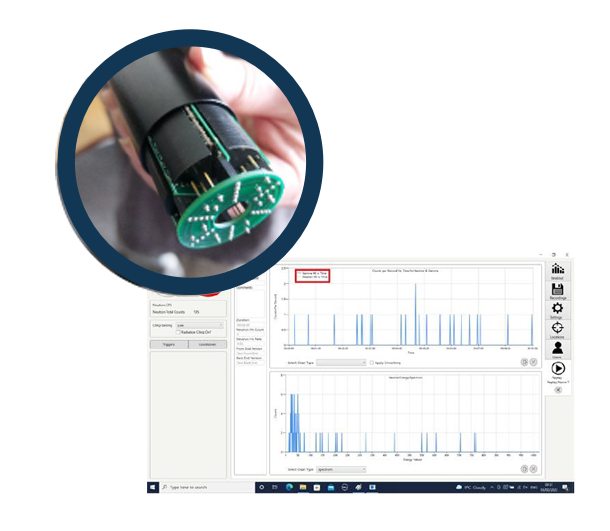
Recognising the need for a radical approach, Innovative Physics defined a strict set of parameters for this physics development project to guarantee robust and reliable operation in severe conditions:
- Sensitive neutron detection capability with accurate flux measurement
- High insensitivity to gamma radiation up to 100 Gy/hr
- Radiation-hardened sensor and electronic circuitry functional above 50°C and humidity over 90%
- Remote operation and monitoring using cables extending to 80 meters
- Must operate for prolonged periods with minimal maintenance
Our technological and scientific rigour enabled us to design a detector system that could perform each aspect without compromise.
The Development
Our team combined advanced materials science and device engineering to create a breakthrough neutron detection system. Key features of the final product include:
- Innovative deployment of Silicon Carbide (SiC) and Boron-10 (B10) materials for exceptional resilience to both high radiation and temperature
- Iterative sensor design, optimising neutron capture while minimising interference from alpha particles
- Thorough testing of detector ASICs and housing for prolonged operational life
- Modular construction for integration into the PCVs at Fukushima
- Designed, manufactured and tested by Innovative Physics in accordance with ISO 9001 and Cyber Essentials
By applying technological expertise, we provided the civil nuclear sector with a specialist, robust solution able to facilitate safe investigation and extraction of hazardous debris.
Read One of Our Case studies Download Now
Quick Links
Contact
Locations
UK
Innovative Physics Limited, Landguard Manor, Landguard Manor Road, Shanklin, Isle of Wight, PO37 7JB
Japan
Nihon Innovative Physics, Level 3, Marunouchi Nijubashi Building3-2-2 Marunouchi, Chiyoda-ku, Tokyo 100-0005
USA
Innovative Physics Inc., 201 N. Union St., Suite 110, Alexandria, VA 22314
Ready to discuss how we can help solve your technical or scientific challenges?
Contact us for a confidential, no-obligation conversation